What is AMSL?
Last update: Mar.01,'09
History
Autonomous Mobile Systems Laboratory* (AMSL) is a research laboratry at the Department of Mechanical Engineering, School of Science and Technology, at Meiji University. The research topics are mechanisms, sensing and control of mobile systems on natural field, e.g., land, topwater or underwater, air and space. Refer research pages for more details.
AMSL was established in 1995 at Ikuta campus in Kawasaki city. The first students joined to the laboratory from Spring in 1996.
From 1997, the director Dr. Y.Kuroda has been a cooperative research member of the Institute of Space and Astronautical Science (ISAS), Ministry of Education (Now organization has been changed to be a department in JAXA), has started to do the research for moon surface exploration system (generally it is known as a moon rover).
* 日本語での当研究室の正式名称は「ロボット工学研究室」となっています.
Resources/Facilities
AMSL has owned many sofisticated resorces and facilities to carry out high-quality research. Human resorce is the most important issue to solve problems. We have a number of well-trained graduate and undergraduate students to dedicate to these tasks. Followings are descriptions of some of our facilities.
Tiny Power - Intelligent Motor Controller
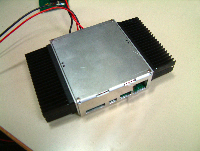 Tiny Power
(preliminary image)
Tiny Power is our original intelligent motor controller unit. It allows to use 6-30VDC single power source and two 300 watts brushed DC motors.
Tiny Power is not only a motor driver or a motor controller, but also a motion controller for mobile robots. The products are commercially available at
Okatech Inc.
タイニーパワー・インテリジェントモータコントローラは,当研究室のInfant移動ロボット開発で培われたノウハウを盛り込んだ高機能なモータコントローラです.単なるモータの制御だけではなく,2軸のモータを同時に制御して移動ロボットのモーションコントロールができます.アナログポートにポテンショメータをつけることで,位置サーボコントローラとしても利用可能です.プロの方にはインテリジェント機能をスキップして単純なモータドライバとしても利用できるように配慮しています. 6-30V単一電源で動作し,使用条件にもよりますが,2個の300ワットクラスのDCモータを駆動できます.モータ駆動電流検出機能付き.インタフェースはシリアルまたはイーサネットで,多数のコントローラを接続できるマルチコントローラポート,アナログ入力×3ch/デジタル入出力ポート×4ビット/2相エンコーダ入力ポート×2chが付いています.
オカテックより発売.
Mobile Robot Testbeds
Micro6 debut!
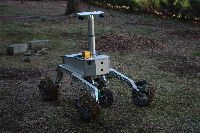 Micro6 rover
Brand-new moon rover prototype called "
Micro6" was unveiled at ISAS/JAXA Open House on Aug.9,'08.
Micro6 has been planed by the rover R&D project group which consists of ISAS, Chuo univ. and Meiji univ.
, has many of cutting-edge technologies, e.g., mobility, sensing & navigation, were demonstrated at the ISAS Open House.
8月9日.当研究室と宇宙航空技術開発機構宇宙科学研究本部(通称:宇宙研)および中央大学で共同開発した最新鋭月面探査ローバ "
Micro6" が宇宙研一般公開でデビューしました.
Infant & Infant mini
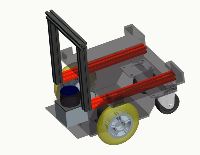 Infant mini
Infant と
Infant mini はどちらも当研究室の
Infant Prototype を元に開発された移動ロボット研究用台車で,
オカテックより発売されます.
Infant と
Infant miniの違いは基本的に大きさだけで,どちらもインテリジェントモータコントローラ
Tiny Powerによって駆動されるため,ソフトウェア互換性を持ちます.
Infant は,
つくばチャレンジのような屋外走行ロボットの台車に最適です.
Infant mini は,屋内用の小型ロボット台車であり,移動ロボットの学習用やマルチロボットの研究用として,また
Infant用のソフトウェア開発に向けたクイックプロトタイピング用として用いることができます.
Infant Prototype
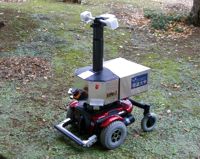 Infant Prototype
Infant prototype is a versatile mobile robotic platform in our laboratory. As shown in its name "I.N.F.A.N.T.: the
Integrated Foundations for Advanced Navigation Technology", the robot is designed for dedicating research of advanced autonomous navigation. Since our main concern on this robot is software systems and algorithms to navigate itself intelligently, we do not care what mechanisms of mobility is used but its robustness. So the current version of the Infant uses powered wheel chair as its mobility base. Infant participated in the first Real World Robot Challenge "Tsukuba Challenge 2007 " held on Nov. 17, 2007.
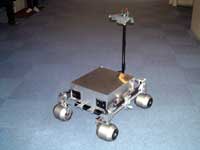
Micro5 TOURER
After the research of
Micro5s, we developed a new testbed for mission oriented research such that it allows to execute a series of mission sequence so as to integrate the results of researches achieved. The rover ss named
TOURER, which stands for "
Testbed for Unknown / Unstructured Terrain Roving and Engineering Research."
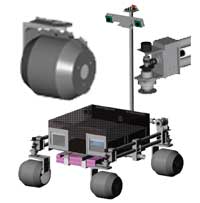
TOURER is equipped with a stereo vision system, IMU with fiber optic gyro, four networked high-speed processors with two vision DSPs.
Micro5
Micro5 is the name of a series of rover testbeds. The first model was designed to realize small enough to be loaded on the ISAS's M-V rocket as a piggyback.
Micro5 is made of CFRP/Kevlar composites, weighted only five kilograms exclude science payload. It is equipped with five wheeled, low power and high mobility supension system called PEGASUS. Thanks to the PEGASUS,
Micro5 can climb up no less than 15cm high of steps with only 10cm diameter of wheels.
Micro5 has been produced three models in a series for different research objectives, e.g., mobility, manipulation, and navigation, respectively. The first and second models are now on the ISAS and Chuo university.
Onion/Onion2
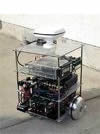
Onion
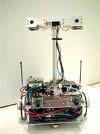
Onion2
Onion is a two wheeled testbed for sensing and navigation research. It is equipped with a differential global positioning system (DGPS), and can carry out sensor-fusioning with odometry by on board processor.
Onion2 is the sequel to the
Onion, with two sets of stereo vision systems. The one is on the top of the mast with pan/tilt stage for over-looking, localizing and map building, and the other is set in front of the vehicle to avoid collision.
Embedded/Networked Computer Systems
We have a lot of skills to cope with embedded computer systems to realize compact and smart robotic systems. We usually use RENESAS's H8 or H8S for smaller systems, or SH series for relatively bigger, computational-power-eater systems. m-iTRON which we use is one of the finest real-time operating systems for smaller embedded systems. For bigger, more complex systems, we use Linux operating system.
We are very much concerned about distributed network systems. In the hardware level, we often use serial buses e.g., serial token ring, RS-485, CANbus and Ethernet. Using serial buses are great helpful to reduce complexity and increasing robustness for creating robotic systems with large amount of I/Os. Ethernet is adopted in TOURER rover.
In a software level, we use multi-tasking with semaphoes and/or message-passing inter-process communication techniques on the real-time OSs. On Linux or Unix systems we use multi-threads, or multi-processes with client/server network architectures. For instance, many threads are running inside TOURER rover, and up to 20 processes are running for MVS: a virtual environment software with client/server architecture.
Knowledge of what distributed systems are and how to make them is very important for creating the next generation cooperative robotic systems.
Stereo Vision System / Vision Processing Unit
We have developed our own stereo vision system, named "
Real-time Self-localizing Vision (RSV)" system. The system can automatically extract multiple feature points from natural terrain without any prior information, and can track them to know its position by itself. The performance of the system has been examined by using the testbed rover
Micro5 and
TOURER. It is proven that it works very robust with precision on the rugged terrain even if it it is on outdoor, under the sunlight condition.
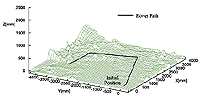
Currently, we use IP7500 for vision processing, and it can calculate its position for every 0.4 [s] within approximately 2% of accuracy. The RSV can also create a map automatically as shown in the picture on the right.
IMU (Inertial Measurement Unit)
IMU is a sensor to know attitude by measuring accelerations and/or angular velocities. We have two type of IMUs, one is a 1DOF, fiber-optic gyro (FOG) based unit with Kalman filtering processor, the other is a 3DOF, vibration gyro based unit with the filtering processor. The FOG based IMU is extreamly accurate, can measure the angle of rotation within 0.5 [deg/h] of drift.
DGPS (Differential Global Positioning System)
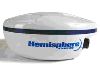
DGPS unit
We utilize gobal positionins sytem to know the position of robotic systems. Especially, it is very good for applications where the systems work at widely-opened area, i.e., ocean/lake surface. GPS with differential functions (known as DGPS) has great accuracy within 1m in diameter.
GPS is, however, very weak where it is used in closed area like inside of buildings, tunnels, under over paths, or even it is on the street of city. We have many up-to-date techniques to be able to use such GPS in any place with multiple sensor fusioning.
Laser Range Finder / Laser Scanner
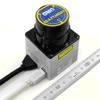
Hokuyo's laser
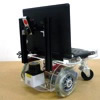
on Infant mini
Laser scanner is one of very useful sensors for measuring shape of environment or obstacles. The sensors made by Hokuyo denshi inc., we usually use for those of our mobile robots, are extreamely high quality with small size and energy consumption. Some new models can use outdoor environment up to thirty meters range.
CAE/3D-CAD
We usually use Pro/Engineer and Pro/Mechanica to design mechanical systems, and Pro/Desktop is used for lighter jobs or for preliminary designs. These three-dimensional tools are somewhat more than one digree-of-freedom larger in comparison with those of two dimensional. These tools permit to think things in 3D and to make clear whether it could be produced. It can also be used to manage structural strength, vibration, and even movable mechanisms. Well designed parts could be manufactured directly from Pro/Mechanica with following CNC or Stratasys production systems.
CNC (Computerized Numrically Controlled) Machine
TBD
Rapid Prototyping System
TBD